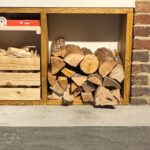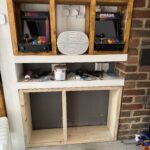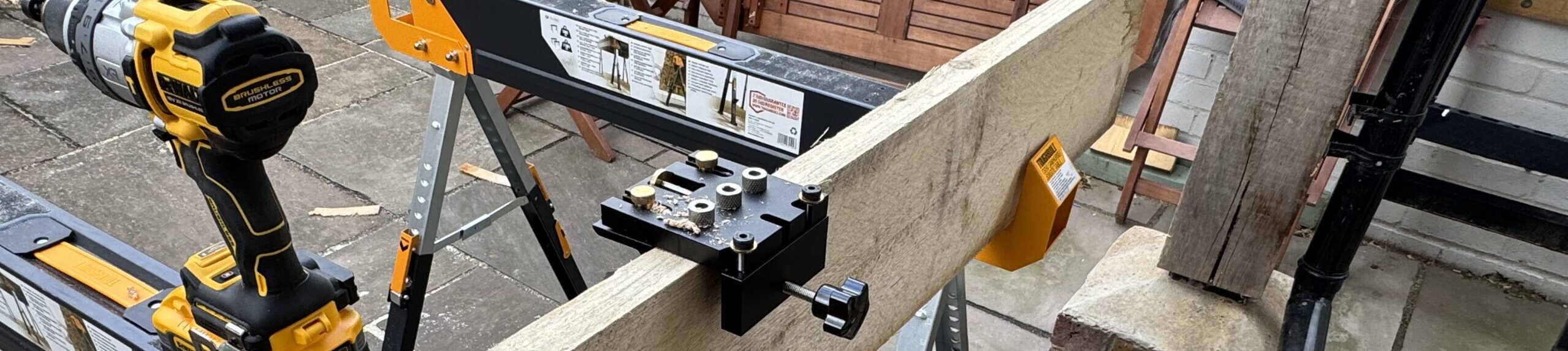

Normally I would start a project entry off by detailing the materials, difficulty rating and tools used to complete the work – but the kitchen shelving is unique for a few reasons.
Firstly, I built the shelving as part of the Kitchen refit project – where the shelving elements such as effort, materials, cost and tools have already been covered in this post.
Secondly, it was this shelving that ultimately led to me getting the bug for carpentry and making things from scratch.
You see, up until this point I had been doing all of the DIY with the sole goal of getting my home just into a state where it was viable. I was doing stuff through necessity rather than joy. With the work that I had done on the damp in the kitchen and then doing the refit I had, quite by accident, arrived at the point where I was going to do something that was was both for practicality, but also for a little bit of joy.
I needed shelving for additional storage space (the practical bit) and I wanted shelving which fitted in with the rustic “galley kitchen” theme I had planned. There wasn’t anything that I could buy which met either my vision or the measurements that I needed. Where I had fitted the cupboards in the kitchen there were gaps. They were expected – but ultimately represented a waste of usable space, so when combined with my needs, the look I wanted and the fact that I could not find something to buy which met the look I wanted – my only choice was to make.
I have never made anything before. Well I say that – I had never made anything that was designed to be permanent, used every day and to a very specific look.
So making this shelving from scratch was very new to me and a little daunting.
However in doing so, I discovered that I actually had a love for both DIY tasks (beyond it being just something that I had to do) and a passion for learning how to make things out of wood. My father was a master carpenter – a level that I will never reach, but he had discouraged me from picking up tools. On the one hand I suspect that he thought that I would be a danger to myself, the materials and anyone around me – but on the other, I don’t think that he wanted me to pursue a trade in life. I think that he wanted me to do something different. Be something different.
He had a long, but hard career as a trade. He was self employed for most of his life. This led to many times being laid off with no notice, not being paid for site work that he did in good faith, having his tools stolen, traveling everywhere just to get a day’s work to support a family for just another week. He finished out his career working in a joinery firm which whilst gave him security – the work was mainly with MDF and to set plans which didn’t test him and his passion for the work was gone.
I don’t think that he wanted any of that for me. So, through his guidance I took a different path in technology – which has worked well, but, a consequence of that approach I felt for most of my life that being able to do anything “handy” was beyond my capabilities and, as it turned out – I missed out on a hobby that at the age of 48 I discovered I was reasonable at!
You may have picked up on the fact I talk about my father in the past tense. Yes, he did sadly pass in 2007 at the young age of 67. But not before having given me so many life lessons which I hold so very dear and many years of laughter and love – so in a weird way part of this site and the projects I do are in honour of him. Even though I do believe he’d look at quite a bit of my work and laugh his arse off!

Anyhow, all of that segue has detracted from the fact that I was making some shelves!
I essentially needed two of these units – so the following is what I did twice!
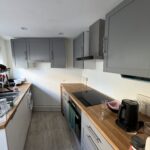
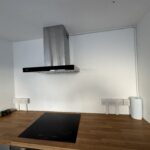
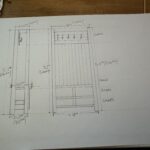
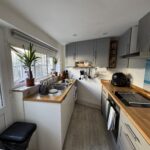
First up I needed to get some measurements from the gaps between the cupboards in the kitchen – the idea was one shelf would come down to extend past the bottom of one cupboard (on the back wall) and the other unit would be exactly the same height of cupboard on the wall where the cooker was located.
After getting the measurements I grabbed a length of my reclaimed Spruce scaff board and some lengths of my rough sawn pine timber and measured them out for a top middle and bottom shelf (from the scaff board) and then 4 support slats from the rough sawn pine in line with the numbers that I had taken from the kitchen.
These I slapped on my DeWalt miter saw (I didn’t really just slap it on, I was a little more careful as I like my hands) and cut them to the sizes that I marked out.
I then sanded all of the pieces down taking them from 80 grit all the way up to 240 grit, ensuring that I cleaned each piece between sands.
It is very easy to skip the clean up steps between sands – but don’t! If you leave sawdust on the surface of the material you will in effect be grinding that into the wood which will impact your finish when you come to staining the piece. So as a tip don’t skip the clean up.
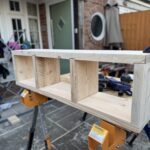
With the pieces sanded I needed to cut some notches into the shelves. I didn’t want a finished look where the supports overlapped the edge of the shelves. To my mind all I would have made was a rectangular box with gaps in. I wanted a rustic look to the units but level lines all the way around – e.g. make it look like it had been joined rather than just slung together with a few screws.
With those done it was assembly time! Now – the eagle eyed amongst you will probably be thinking – shouldn’t you stain these first.
You’re absolutely right. I should. It is a ball ache staining with pieces put together.
The main reason why I didn’t was purely confidence and perhaps a lack of patience. At this point when I was making these I really didn’t know what I was doing. Whereas it is debatable I know what I am doing now – at this point I had no clue if what I was doing was going to work out.
I needed to see them fitted together and once I had done that I didn’t want to take them apart again.
All of my more recent projects I have built the components, stained and then assembled.
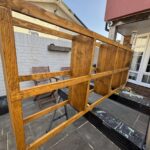
Anyhow the assembly was a lot of fun and was made easier clamping the bits together which was especially helpful as some the rough sawn was slightly bowed and the clamps helped straighten it all out prior to screwing them in.


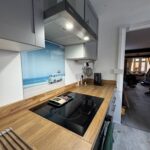
I will show the pictures of them fitted in the last part of the kitchen refit series.
Under counter shelving
It was now time to make the final shelving unit for the kitchen.
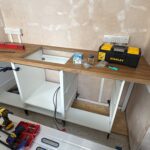
There was a gap between the last drawer until and the back wall of the kitchen which needed something. I originally cut a Wine rack but once fitted I looked at it and thought “It’s a waste space and I don’t even like wine” – so out it came.
So I decided on another shelving unit – but it would need to be different from the other two that I had made as it needed to be angled due to the back wall that it would need to slide in against.
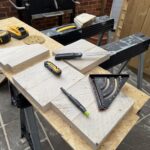
I started out be taking an angle reading off the back wall which was around 28 degrees – then took the rest of the measurements for the gap so the unit would be an exact fit. I parked the angle for the time being as I would cut that a little later – so I took the measurements to the remaining timber that I had from the Spruce boards and cut them alongside three rough sawn frame battens.
The next thing that I did was to cut the notches into the shelves and using my Bevel Gauge mark up the angle lines so it the shelving would slot nicely against the back wall of the kitchen. All this cuts I made with my DeWalt Jig Saw and did them freehand which worked out far better than I thought as they were both clean and straight.
After I had completed the cuts it was time to sand all the parts down ready for assembly and then staining – the process of that you can see in the photos below.
As I assembled it occurred to me that it was possible for items that I put in the shelves to fall off down the back of the unit and that would be a major pain in the arse as I would have to take the unit out each time it happened so it was going to need some kind of backing.
Luckily, I had a load of 6mm molded MDF panel board left over from when I first did the kitchen – so I measured up the back of the selves and cut some panels to size which I painted and then fixed into place.


That was pretty much that – three shelves from off the top of my head in two days – not bad for a first go!